
Many wonderful nurses wouldn’t be where they are today if they hadn’t been able to make use of nursing school grants to pay for all or part of the nursing education. Today’s nurses are strong and capable professionals who must go through rigorous training and testing in order to hold their positions.
A solid education is the first step in the process. Unfortunately for many, funding is the one stumbling block that prevents them from getting the necessary education.
Don’t let this happen to you. There are many excellent grant programs out there that are designed to help educate nurses.
Why are there so many grants available?
Aside from the fact that nursing is indeed a noble profession to pursue, it is also a profession in which there happens to be a major shortage of qualified professionals. Within the next decade that shortage will reach a critical stage if something isn’t done now to bring in new nurses for the coming years.
One of the strategies to combat the nursing shortage before it becomes a crisis is to offer grants specifically for study in nursing schools around the country. This brings in new nurses graduating each and every year and it also, by stipulation in some grants, ensures that these new nurses will serve a minimum term of service in areas where the need is greatest.
These are often hospitals or institutions and health care facilities that have a high need for nursing staff.
This video about nursing school grants explains things well…
4 Federal Education Grants for Nursing Students
Students seeking an education in a nursing profession have a few more options available to them for financial aid than students in almost any other major. One possible exception might be education. The difference though is that nursing students can qualify for exceptional grants, scholarships, and even student loan repayment services while also earning an impressive income.
These are two nursing school grants or scholarships that are offered by the U.S. Federal Government:
- Scholarships for Disadvantaged Students: This scholarship is available to students who have a financial need for assistance and are entering into a field of study that involves health sciences.It does not need to be repaid and includes, but is not limited to, students who are entering into nursing fields of study. Application should be made through the financial aid office of the college attended and awards are made based upon funds available, financial need, appropriate major, and other criteria.More information is available on the official web site.
- Nursing Scholarship Program: This scholarship is more than just a grant to cover the cost of tuition. As such it is highly competitive. It offers full tuition and other reasonable education expenses (such as books, lab fees, uniforms, travel, and insurance) plus a stipend of more than $1,000 per month.In order to receive this scholarship, nursing students must agree to work in a high-need facility for a minimum of two years after graduation. You can learn more about this scholarship here!
There are two general federal grants that, although not specific to nursing, can be applied towards an accredited program….
- Pell Grant: Full details on the Pell grant can be found here.
- Federal Supplemental Educational Opportunity Grant: Full details on the FSEOG program can be found here.
Applying for either of these two grants is easy… just submit the Free Application for Federal Student Aid (FAFSA).
More details on how to do that can be found here!
In addition to these nursing school grants there are several programs offered by the federal government that offer student loan repayment after graduation from a qualified (accredited) school of nursing.
These loan repayment offers are extended for things like pursuing advanced education in nursing fields where critical shortages already exist, practicing in high-needs facilities, and working in underserved areas (Indian reservations, rural communities, and urban centers for example).
For new nursing student graduates, these loan repayments offer a major savings over the life of the loan and the elimination of a huge financial burden that is well worth considering.
State Level Nursing School Grants
Many U.S. states offer their own funding to help students become fully certified as nurses in an effort to address their own shortages of these professionals.
For example, Delaware offers the Nursing Incentive Program, Nebraska offers the Nursing Student Grant Program and Oregon offers Medical, Nursing and Dental Program Grants. To research the opportunities that may be available at the state level, check out our Grants & Scholarships by State page.
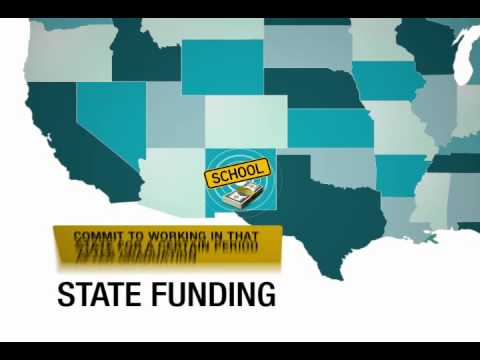
Most of the state level funding opportunities come with a catch; you’ll be expected to work in the state for a certain period after graduation. No point in the government giving you money to become a nurse and then have you go and work in a different state or country, is there?
Professional Nursing School Grants Available for Advanced Nursing Education
For the most part, professional grants for nursing students are available to existing nurses that are pursuing advanced degrees.
Some are very specific in nature.
Make sure you read all the fine print before you accept any financial aid for nursing school so that you know what the stipulations, requirements, and expectations will be.
- The Gerontological Society of America offers scholarships and/or grants to students who are doing advanced graduate level research in areas of study related to aging.
- The Emergency Nurses Foundation Association offers grants and scholarships at all levels of study but these are based on the amount of money available and awarded to emergency room nurses.
- The National Health Service Corps offers both scholarship and loan repayment options for those willing to give two to four years of service in exchange for financial assistance. In order to receive these funds nurses must have either a master’s degree or post-master’s degree as certified nurse-midwives or as nurse practitioners.These scholarship awards include tuition, fees, and other educational expenses for up to four years of education. They also include a monthly stipend that is a little over $1,000 a month as of 2010.
Is there a special secret for getting these scholarships and grants?
Nursing scholarships are greatly coveted prizes in some areas and more freely distributed in others.
Your odds of being awarded one of these academic prizes depends greatly on the level of need in specific communities and the number of nursing students competing for the same scholarships and grants.
That being said, there are things you can do that will greatly improve the odds that you will be successful in getting the nursing school grants you need.
Do these things when you apply for limited financial resources like grants and scholarships to ensure that your application doesn’t hit the reject pile before it even has a chance to be accepted.
- Read all instructions completely and follow them to the letter. You’d be amazed by the sheer volume of applications that are rejected each and every year based on technicalities rather than ineligibilities.
- Apply for any and all grants and scholarships for which you are eligible. The more spaghetti you throw at the wall the better the odds that one of the noodles will stick.
- Write a unique application and cover letter for every single grant for which you apply. Make sure that your letter and application are thorough and appropriate for the specific grant you seek. Complete and send off one before you begin another one so that there is no chance of the wrong application being sent to the wrong destination.
- Have someone else review all applications before you send them out. There is nothing like a fresh pair of eyes to catch potential mistakes or even point out qualities, characteristics, awards, and accolades that you may have forgotten to include in your application. Always have a trusted friend or mentor double check your work for formatting or grammatical mistakes as well as spelling errors and failure to include pertinent information.
Money is tighter now than ever before for many students preparing for school. This grants and scholarship article should help you have the leg up on paying for your nursing education when the time comes.
Resources
- The Nursing Shortage in America
- Occupational Employment and Wage Statistics (Bureau of Labor Statistics).